Hello, I’m Crafty Olive. I recently built a game on Roblox and took it as far as a round of testing.
To get straight to the point: I ran into its limits and decided to stop.
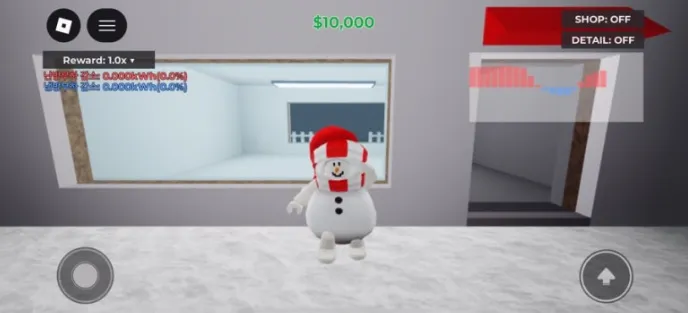 My Roblox project, which didn’t make it
I’m reasonably happy with how far I got in modeling heat transfer. But installation, accounts and platform requirements all stood between players and the game, and that made it hard to reach the kind of accessibility I wanted, where anyone can click a link and start playing right away.
Then, at the end of February, I visited a reptile exhibition with my son. A shrimp-catching activity there left us, quite suddenly, with eight cherry shrimp to take home.
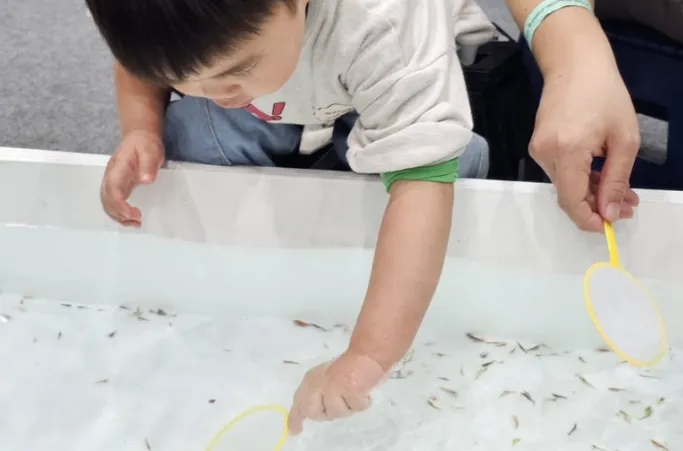 My son catching shrimp
The problem was that we had no tank.
I ordered one for next-day delivery and spent the time in between anxiously adjusting the water temperature and changing the water, worried the shrimp wouldn’t make it through the day. If they died because of something I did wrong, I knew my son would be heartbroken.
Fortunately, all eight are still alive and well.
That was when an idea came to me: what if I took the energy modeling I had been building in Roblox and applied it to a shrimp tank?
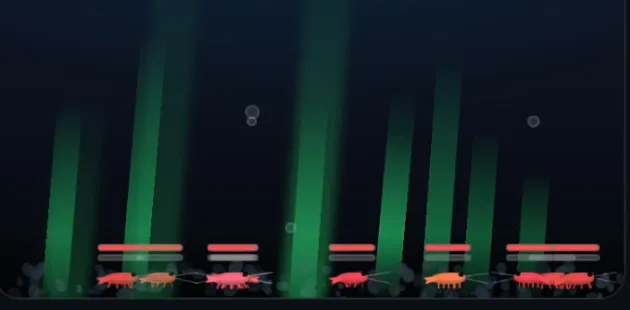 Cherry shrimp and their tank, recreated in the game
Keeping a shrimp tank is genuinely enjoyable. The variables I can control are food, temperature, aeration, bacteria, plants and filtration. What comes out of them is dissolved oxygen, rising ammonia (NH₃) toxicity, nitrogen compounds from the nitrogen cycle, biofilm, microbial growth and changes in the shrimp’s condition. These outcomes feed back into one another, and the web of cause and effect is complex enough that it feels like running a small world.
So I decided to build a shrimp simulation that combines thermodynamics (temperature and energy), chemistry (water quality and the nitrogen cycle) and biology (behavior and stress), and to shape it into a game. I wanted to create an experience of caring for a small ecosystem while coming to understand how causes lead to effects.
I also moved the project to the web. Now anyone can reach the test server with a single click, and in the long run I plan to release it as an app on the App Store and Google Play.
Much of this is thanks to vibe coding, made possible by recent advances in AI. As long as you understand the overall local/server architecture and the broad shape of the algorithms, the barrier to development feels dramatically lower.
I’ll share the full development process soon.